
Capacity


A special meeting of the village council was scheduled during my final week as interim manager. Members of the executive team were seeking decisions on time-sensitive matters related to a $3 million street improvement project that would start this spring: awarding a contract to a paving company; approving a proposal for construction engineering services; approving a resolution authorizing the sale of bonds to finance a portion of the cost of the project.
The public works director, clerk/treasurer, and I had met on several occasions to discuss various aspects of this endeavor. Our objectives included establishing a balance between debt financing and use of reserves that would keep principle and interest payments at the same level as was currently the case while retaining sufficient funds on hand to address other needs for street improvements in future years.
During one of our meetings I completed a rough calculation and determined that we should sell $1.7 million in bonds. On the morning of the meeting, the clerk/treasurer let me know that she wished to go over the numbers one more time to satisfy herself that $1.7 million was the right number. When we met, and used less rounding, we concluded that we should increase the amount of debt to be issued by $100,000.
As I expected, council members’ primary interest in the project was how we were intending to pay for it. We laid out the basis for our recommendations, walking through the various factors that led us to the determination that we could afford to take on a project of this scope while still retaining sufficient reserves to meet future needs in the street funds.
When I met with the village president later in the week, I remarked that the approach we had taken to achieve the comfort level among staff and the council with staff’s recommendations on this matter was among the best work with which I had been involved during my career. It was particularly noteworthy because it was achieved by a very small number of administrators exhibiting considerable skill and attention to detail. I encouraged her to recognize that having a team with this capacity provided an opportunity to take on other significant projects in the future, those that would help distinguish the village from other small communities.
Building capacity in an organization starts with recruiting and retaining talented people with a commitment to performing quality work. It requires investing in them. These investments include more than sending them to training programs, although this is certainly important. Investments must also include executive time devoted to guiding them toward a fuller understanding of their roles in the organization and helping them see the thought processes that affect recommendations the executive is making. In addition, team members must be involved early in the planning and design phases of a project so that they can see all that goes into decision-making. Their input should be solicited frequently and address seriously.
The clerk/treasurer had expressed uncertainty regarding the issuance of bonds because she had never been involved in doing so. A part of my job was to assure her that the complications associated with this would be managed by competent professionals with years of experience in completing tasks associated with the process. I made certain she was involved in every part of this process, something particularly important to insure a smooth transition between me and the incoming manager.
Capacity-building directly and indirectly related to this project occurred over the entire two years I spent with the organization. I worked with the public works director to select a new engineering firm for the project. The clerk/treasurer and I devoted time to evaluating cash flow to better understand current fiscal needs while optimizing returns on surplus funds. That cash flow evaluation and decisions about investments included an understanding of when bond proceeds would become available relative to when contractor invoices would need to be paid.
Developing staff capabilities and managing finances with a view to the long-term needs of the organization are only two components of capacity-building. It is important when taking on big projects that systems are in place to assure that the basics are done well. This requires attention to workflow, correcting deficiencies and inefficiencies wherever they are discovered. It is also important to have technology and communication systems in place that work for the team, not against it. Further, attention should be devoted to strengthening relationships with stakeholders so that they maintain a high level of trust in the capabilities of those with whom they are dealing.
In a municipal organization, capacity-building must include informing and engaging members of the governing body. Village officials have committed to holding a retreat early in the tenure of the new manager to develop a strategic agenda. This is an important first step, one that needs to be continually reinforced by providing quality information about what the executive team is doing and why to accomplish the agenda. Although a municipal executive does not select those for whom he or she works, the process of orienting new members of the governing body is crucial to the development of their leadership potential.
During a recent budget work session, a council member appointed to fill an unexpired term just a few months earlier offered a suggestion for a small addition to the proposed budget. Her suggestion was not acknowledged by any other member of the council while those offered by others were. I called this to the attention of the village president a few days later, suggesting that this could discourage the new member from offering input in the future. The president reached out to her and suggested she offer an amendment to the proposed budget when it came up for adoption. She did and the amendment was approved.
One of the skills good executives need to develop and practice is awareness of opportunities for capacity-building. This starts with an appreciation for the culture and dynamics of the organization and an awareness of its strengths and weaknesses. No opportunity should be overlooked to improve upon the capabilities of those associated with the organization. The goal should be to increase the functional potential of the entire team so that the executive is needed less and less for ongoing operations and can devote more of his or her time and energy to strategy and planning.
Guiding an organization toward greater capacity must be strategic in its orientation. Absent a focus on the big picture and the destination toward which the executive wishes to point, there will be a danger of micromanaging. All areas ripe for improvement are not of equal importance. Attention must be focused on those that offer the greatest opportunity for moving the organization forward in the long run and for accomplishing short- and medium-range goals.
Capacity-building should be thought of as transformative in two ways. First, the organization is transformed to fully realize its ability to complete its endeavors with a sustainable level of quality results. Second, the organization uses its capacity to transform the community and the world through the confidence it develops by its continued success in achieving those results and more.
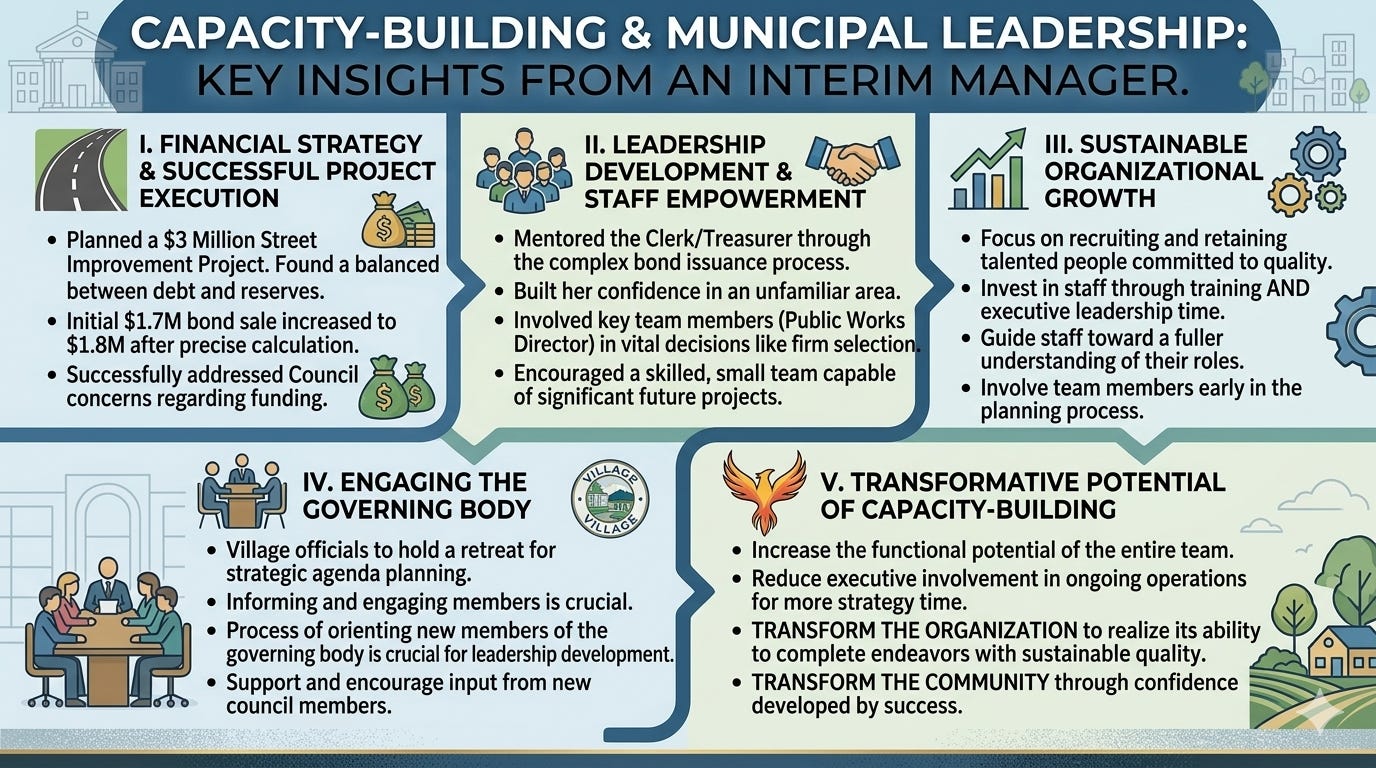
Illustration produced using Bing Image Creator.
Infographic summary produced using Google Gemini.