
Free-Work

Almost two months ago, I completed a two-year assignment as an interim manager. I was asked one or two questions by people when they learned this. The first was whether I had lined up similar work elsewhere. I advised that I had not. For several personal reasons, it made sense to me to forego looking for such opportunities.
The second question was whether I was now fully retired. This question betrays a presumption that, at a certain age, a worker should desire leisure over challenges and accomplishments. This sort of life has never appealed to me, as I discussed when offering the term “repurposed” as an alternative in to “retired.” I want to remain engaged, physically and intellectually, in worthwhile undertakings.
People like simple answers to difficult questions such as whether I am retired. Most do not really want to hear that I continue to volunteer and write. If they did, they might ask “Now that you’re not holding a regular job, what are you doing that excites you?” In some cases, I will respond to their clumsily worded inquiry by telling them what I do. Most of the time, I simply say that I am no longer getting paid to work.
As I have written before, “work” tends to have a negative connotation for many. I suspect this comes from the nature of work that they find to be less fulfilling than other things they can imagine themselves doing. This connotation is captured in the inapt phrase “work-life balance,” a term that highlights the perceived obligatory characteristic of employment with uses of one’s time outside the workplace. It seems we lack a vocabulary that applies equally well when describing activities for which one is compensated and which are done for free. Further, we have failed to adequately capture a distinction between work and leisure that affirms the dignity and value of both.
Because work is seen as a less desirable use of one’s time than leisure activities, people expect to be paid for it. The origin of the word “wage” conveys a sense of a promise to pay for a service rendered. A contract was implied. An individual agrees to perform a task and the beneficiary of that performance commits to paying for the service. There is an exchange of value, one that, for convenience sake, usually involves transferring money. In other times, accounts were settled via bartering or by allowing the laborer to keep a portion of his or her output.
Because of the importance of paid work in the manner in which modern economies are designed, we often ignore other types of activities in which tasks are completed but there is no expectation or promise of remuneration. Household labor falls into this category. We do not expect to be paid for chores and errands. The same can be said most of the time about hobbies in which we engage. Finally, there is a wide range of volunteer activities that, although they involve the expenditure of time and energy to complete tasks, we distinguish from compensated work. In each of these alternative forms of work, some result occurs as a result of the investment of labor, but it is not valued in the marketplace in the same way.
What our language seems to lack is a term that makes clear that one is still devoting time and energy to completing tasks but doing so without compensation or remuneration. Such a term should occupy a middle ground between employment and leisure. The key to the utility of such a word is the dimensions across which we measure these endeavors.
Work and leisure both can be characterized as involving the completion of purposeful activities. This allows for excluding from consideration unconscious investments of time and energy such as breathing, sleeping, and daydreaming. There are important distinctions between work and leisure, however, that can be best identified by considering the difference between a pastime and a job.
Last year, for the first time since we were in our teens, my brother and I went fishing together. We released everything we caught, so our goal was not to put food on the table for dinner. Instead, we were there to relax, tell stories, and laugh. It was a time devoted to rest. In contrast, there are those who fish for a living. They do not release their catches. The work is not relaxing. There might be little time or incentive for camaraderie. In between these two extremes might be those who enter fishing contests in which there is competition for trophies or cash prizes.
We can see through these examples that leisure, in its purest form, is primarily restorative. In that respect it is like sleeping, eating, and exercise, activities we typically exclude from our conception of work. We engage in leisure in part to replenish reserves of energy to be devoted to work.
There is a second dimension to this distinction between work and leisure that the fishing examples highlight. It is the structured nature of the context in which the activities take place. Siblings fishing requires only the consent of the parties. Commercial fishing is a complex undertaking involving employment relationships, compliance with employment and other regulations, extensive involvement with markets and other components of the economy, and so forth. A fishing contest requires a sponsoring organization.
There is a third dimension as well, the benefit that is gained by social groupings to which the individual actor belongs. Apart from the store that sold us the bait, no one benefitted from my fishing with my brother than the two of us. Commercial fishing is a component of an industry devoted to feeding the world and creates jobs in related areas of the economy. A fishing contest might raise funds to be used in support of an organization’s community service mission.
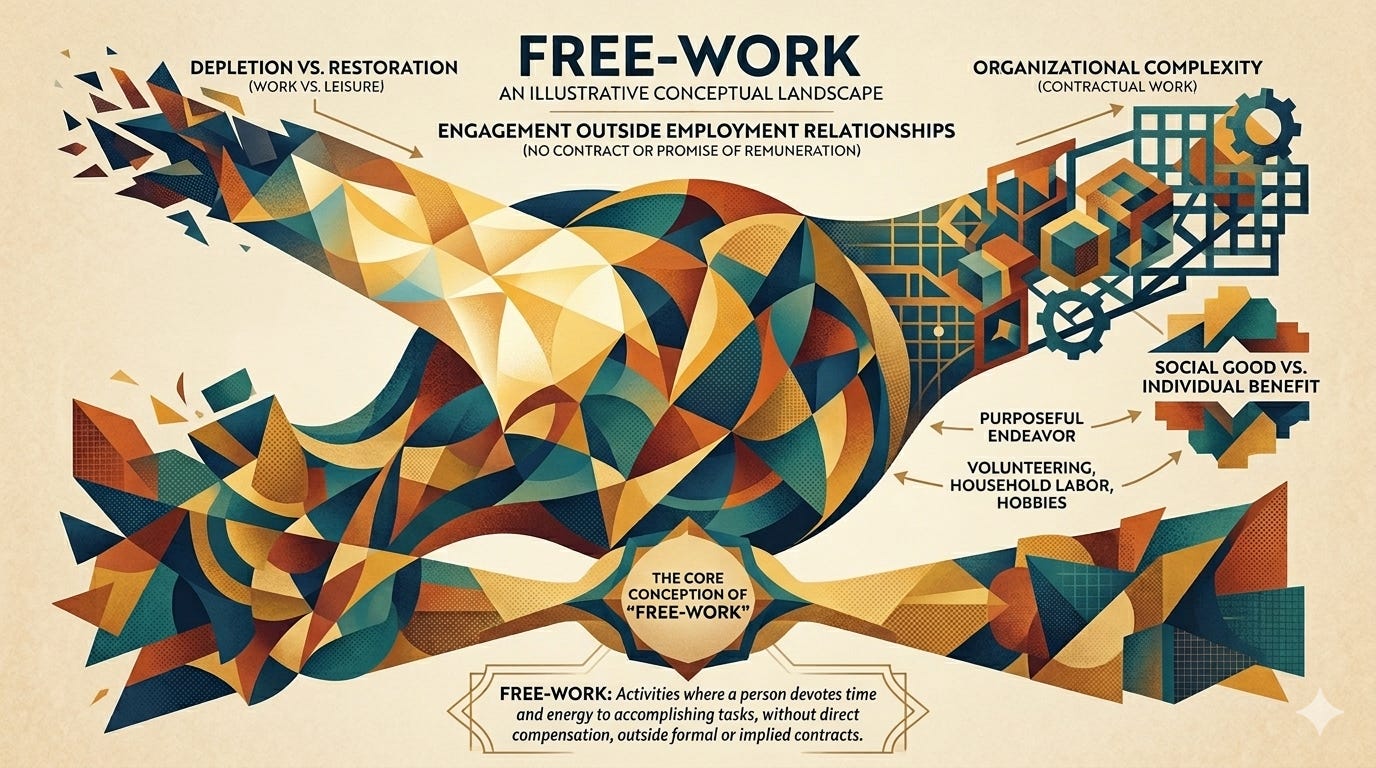
We can now picture our investments of time and energy devoted to accomplishing tasks as falling along continua of depletion vs restoration, organizational complexity vs. organizational simplicity, and social good vs. individual good. Employment and leisure are commonly accepted terms easily associated with the extremes of these continua. What is needed is a term for hobbies, household labor, and volunteering that occupy their middle ground.
I went looking for such a term, even considering whether there was a word or phrase used in foreign languages that captures what I am looking for. I came up empty-handed, so I was forced to coin my own: free-working.
There are two aspects to the use of “free” in this expression. First, free-working encompasses activities for which one is not compensated through a medium of exchange typical of conventional economic activity. Second, free-working occurs outside employment relationships structured through formal or implied contracts.
This conception allows for excluding certain activities from free-work. Pro bono work, performed free of charge by professionals in various fields of endeavor, still occurs within a structured employment setting. Even though no money changes hand between the actor and the beneficiary of his or her actions, the work takes place within the context of a formal relationship between the parties.
Freelance work is more like conventional employment than free-work in that the freelancer is paid for the time devoted to performing tasks. Further, there is typically a relationship established between the parties that takes the form of a formal contract.
Free-work can be transformed into employment or freelance work, moving the activity to a different position on the continua. A few years ago, my wife and I arranged for the construction of an addition to our home. The contractor we hired turned to a local individual who engaged in woodworking as a hobby to fabricate the trim for a new doorway so that it matched the that found elsewhere in the house, labor for which he was paid. That task was freelance work, not free-work.
Now I have a convenient way to reference what I am doing with my time when I am not being compensated, such as when I write articles like this. My work on this topic is done. I just have to wait for the expression to catch on among other members of the general public so I do not have to explain it.
Illustration generated with Google Gemini.